

I became interested in ancient Southwest history back in the 1970’s during my college years. At first, my research relied on the information that could be gleaned from local city and university libraries, mostly due to the fact that the internet was something that was still in it’s infancy. It is no exaggeration to say that I became obsessed with trying to absorb all I could learn about this fascinating, but oft neglected period of American history. Although I read numerous texts and research papers on the subject, it became readily apparent that there were substantial gaps in the historical knowledge base regarding this region. Intrigued by what remained unknown, my interest in researching this subject continued long after college.
“Four Corners” is the term used to describe the location where the state lines of Utah, Colorado, Arizona and New Mexico all come together to form the only geographic “cross” that appears on a map of the United States. Most regional guidebooks refer to the Four Corners region as “Indian Country”. Indeed, there are numerous “Indian” reservations and tens of thousands of ancient ruins, petroglyphs and pictographs scattered across the region. I have personally visited several of the more popular destinations such as Wupatki, Wukoki and Mesa Verde, as well as some of the more remote archeological sites that required a lot more work to get to. Most of these sites remain nameless to this day.
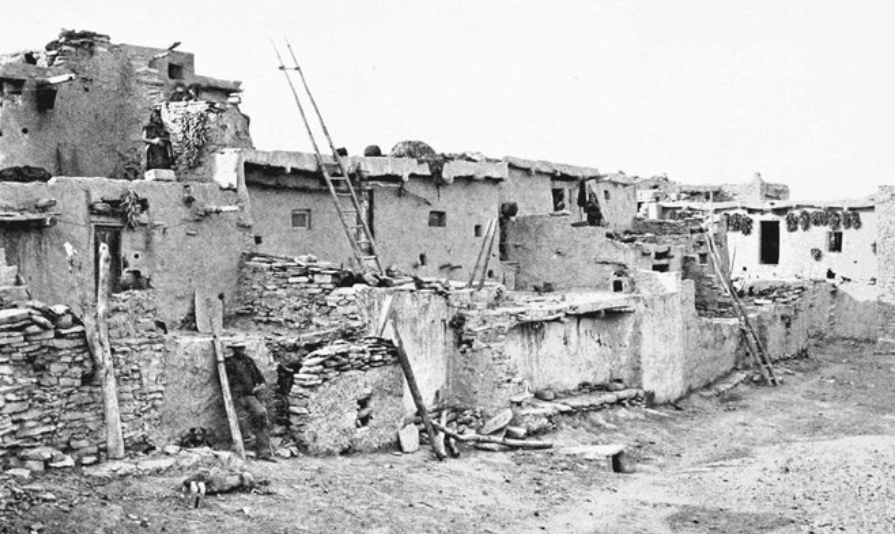
In 1980, (forty-four years ago), I had a “chance” encounter with a Hopi man who invited me to visit him and his family in his home village of Oraibi. For those who are not familiar with southwest geography, the Hopi reservation is located in a remote part of northern Arizona on a series of high mesas which rise out of the surrounding desert like a chain of islands. This traditional homeland of the Hopi people is completely surrounded by the much larger Navaho reservation which comprises some 27,413 square miles. Oraibi has been dubbed North America’s oldest continuously inhabited settlement. This Hopi man told me that I should come to Oraibi in late August to see the “snake dance”. The bizarre ceremony is called Chu’tiva by the Hopi and is described in Frank Waters popular book on Hopi history called, Book of the Hopi, c. 1977. [But this is not the time or place for the telling of all the amazing things that occurred during my visit to Hopiland. Alas, that tale must await another time as the details of my brief adventure in the world of the Hopi would fill a small novel.]
I believe that what I was privileged to witness during my time on the Hopi reservation was anything but the result of a “chance” encounter. Suffice it to say that the experience of being introduced into such a completely foreign culture at such an impressionable age became a key moment in my life. The experience led me to question what I thought I knew about good and evil, the existence of God, the importance of faith, the purpose of life, and where myself as an individual, along with the rest of mankind, fit into this amazing universe.

But back to the purpose of my rant. While working for the U.S. Forest Service on the Bridger-Teton National Forest in Wyoming, I had become intimately familiar with several mountain ranges that lie within the BTNF’s jurisdiction. These mountain ranges included the Gros Ventre, the Wyoming Range, the Tetons, and of course, the Wind River Range. If I could still manage to walk with the strength I had as a young man, I could take the reader to a 10,000 ft. pass in the northern Wind River mountains where fossils of sea life are embedded in the rocks. I could also tell the reader which lakes have which species of trout, and where one might find respite from the clouds of mosquitos that inhabit the valleys and upland meadows for most of the summer. Having developed a knowledge of my home range explains why I was not at all surprised when one of the backcountry wilderness rangers I met in Utah told me that there were over 25,000 ancient archaeological sites that had been mapped and documented in the winding mazes of canyonlands in the state of Utah alone. He went on to say that new discoveries were being made almost every day.

It can be postulated that down through the centuries there must have been hundreds of thousands of people, (perhaps millions), who lived at one time or another throughout the four corners region. The sheer number of cliff dwellings in Utah alone indicates that for at least a century or more, starting about 1200 years ago, people chose to reside in small family groups in hand built stone shelters constructed in remote canyons halfway up steep cliff faces or beneath sheer rock overhangs. So what was life like for these people during this period of history? Who or what were they so afraid of that they had to live in such strategically defensible locations?

Today, many southwest tribes are often referred to as the “Pueblo Peoples”. While some members of some tribes still do live in pueblos, (such as the Hopi, Zuni, Acoma and Taos), the term refers more broadly, if erroneously, to the hundreds of thousands of human beings who called the region home long before Europeans came to the area in search of gold and glory. Many early historians refer collectively to these ancient ones as the “Anasazi”. While there were indeed a peculiar people called the “Anasazi”, those who took to residing in cliff dwellings were not them. In fact, the people known as the Anasazi appear to be the very reason that so many other people fled to isolated locations and built defensible positions on cliff faces throughout the region. While the Anasazi may have indeed occupied some of the larger pueblos, such as Chaco Canyon, and constructed ball courts like the one pictured above at Wupatki, they did not reside in the remote cliff dwellings peppered throughout the region.
Over the years, the evidence depicting the ancient Anasazi as barbarians has grown. If we could peel back the layers of cultural wokeism that naively ascribes a noble character to all things “native”, we would see that the Anasazi were feared throughout the land for their acts of moral depravity and violence. It is readily apparent that these so-called “ancient ones” did not live in harmony with either their fellow man or with nature, but practiced a savage ritualistic culture built on attacking, killing, and/or enslaving neighboring people.
Modern historians claim that nobody knows what happened to the ancient Anasazi. But stories handed down by tribal elders provide evidence to the contrary. (See videos below). There is strong archeological and cultural evidence to suggest that the Anasazi of the American southwest conducted ritual human sacrifice and practiced cannibalism like many of their indigenous relatives further south in Mexico. The people who fled to the canyon lands and became known as the “”cliff dwellers”, included ancestors of the Navaho and other still surviving tribes. Traditional Navaho tribal elders describe a period of time several hundred years ago, when many people had grown weary of being victimized by the Anasazi. These people rose up and banded together in order to wipe the so-called “ancient ones” off the face of the planet.
To be “educated” or “woke” today requires that one believes that indigenous tribal peoples are, by nature, of superior moral character based on their supposed eco-centric worldview. Today’s school kids are taught that indigenous people instinctively know how to “fix the planet”. Environmental groups are promoting the idea that removing the impacts of modern human activity by REWILDING landscapes, is an activity that should be guided by indigenous knowledge. Creating large swaths of protected habitat for the exlusive use of predator species such as wolves and grizzly bears, assuages the cultural guilt that has grown out of our addiction to cell phones, music videos, automobiles, and the convenience of shopping for life’s necessities at super stores.
Today’s woke culture has built idols in the form of all things “native” or “indigenous”. It has gotten so bad that official email communications between employees of the City of Spokane now include statements reminding city employees that Spokane occupies “un-ceded” land that belongs to the indigenous tribal peoples who used to fish and hunt in this region over a hundred and fifty years ago. This “woke” mindset is the result of decades of guilt drummed into the public psyche by an increasingly biased educational experience.
- We acknowledge that we are on the unceded land of the Spokane people. And that these lands were once the major trading center for the Spokanes as they shared this place and welcomed other area tribes through their relations, history, trade, and ceremony. We also want to acknowledge that the land holds the spirit of the place, through its knowledge, culture, and all the original peoples Since Time Immemorial.
- As we take a moment to consider the impacts of colonization may we also acknowledge the strengths and resiliency of the Spokanes and their relatives. As we work together making decisions that benefit all, may we do so as one heart, one mind, and one spirit. We are grateful to be on the shared lands of the Spokane people and ask for the support of their ancestors and all relations. We ask that you recognize these injustices that forever changed the lives of the Spokane people and all their relatives. [“Land Acknowledgement” adopted by the Spokane City Council April 2021]
Landscapes free of barriers, where bears, wolves and buffalo can propagate freely, have become the preferrable alternative to landscapes comprised of fruit orchards, cattle ranches, and wheat farms. No surprise then, that American history is viewed as nothing more than one long bludgeoning of tribe after tribe as greedy white men committed countless unforgivable acts of genocide in order to steal land that rightfully still belongs to some morally superior indigenous tribal people. Our only hope for survival lies in returning the land to a primeval condition and ceding control to some tribal entity. This mindset is most evident in a mission statement from the organizers of the 12th World Wilderness Congress, a.k.a. “Wild 12” whose leadership is calling for “An official declaration reinterpreting wilderness through an Indigenous lens.” The organizers of the “congress” go on to state that, “Traditional cultures are the best stewards of biodiversity and wild places.”
But what is “an indigenous lens”? Is there only one viewpoint, one lens, which all indigenous peoples share? History has shown that so-called indigenous people can be just as flawed in their respective world view, just as incompetent in their understanding of how to get along with their neighbors, as any other people. Indigenous tribes have proven that they can be just as cruel, just as corrupt, and just as morally (and spiritually) lost as anybody else. Covered with a veneer of “wokeness”, racism and idol worship are just not a solution for any of the world’s problems.
Sources for this article include:
https://www.jstor.org/stable/j.ctvgd21w
https://en.wikipedia.org/wiki/Ancestral_Puebloans
This was recently published…..right on topic.
 omots page
.jpg)